
Play Aviator Now!
Home → Demo
Aviator Demo
What the Aviator demo gives you
The developer Spribe released Aviator in 2019 as a crash game with no reels or paylines, establishing a theoretical return of 97.00% over millions of rounds. This RTP implies a house edge of exactly 3.00%, meaning players lose three euros for every hundred wagered in the long run. Consequently, the demo illustrates how the rising multiplier behaves without risking real funds, allowing users to understand the mechanics before playing with money.
Unlike slots that rely on spinning symbols, this title features a plane flying upward while the multiplier increases continuously until it crashes unexpectedly. The maximum potential win is capped at x1,000,000, which defines the upper limit of any single round regardless of the bet size placed by the user. Players can observe this high-variance outcome repeatedly in the demo to grasp the risk profile inherent in the continuous rise and sudden drop mechanism.
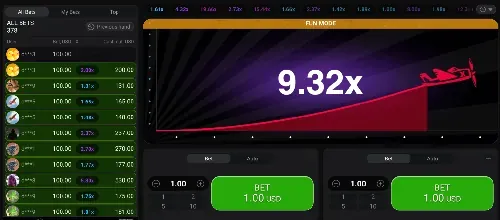
Starting the demo without registration
Accessing the free version requires no personal data or account creation, unlike real-money play where operators demand full identity verification through KYC procedures immediately. Users simply navigate to the game page and click the play button, bypassing the standard registration wall that usually precedes depositing funds into an active wallet. This instant access allows for immediate testing of the dual-bet mode and auto cashout settings without committing to any financial transaction or time constraint.
The interface loads directly in the browser using standard HTML5 technology, ensuring compatibility across desktop and mobile devices without requiring additional software downloads or plugins. Since the game operates via SHA-256 cryptography combining server seeds with client seeds, the fairness is certified by iTech Labs and BMM Testlabs independently. These audits guarantee that the random number generation remains unpredictable, providing a secure environment for users to familiarize themselves with the betting feed.
Demo balance and bet sizes
The virtual balance provided for practice purposes typically starts at a fixed amount, such as 1000 units, which resets automatically if the player exhausts all funds during a session. Unlike real accounts, this balance cannot be withdrawn or converted into cash, serving solely as a tool to test strategies like adjusting bet sizes between rounds. Players can experiment with low stakes starting from 0.20 credits up to higher limits to see how different wager amounts affect their overall bankroll management strategy.
In contrast to other titles like Chicken Road offering max wins of x3,608,855, Aviator caps its highest possible payout at x1,000,000 regardless of the total accumulated bets. This cap applies uniformly whether the user places one large bet or two smaller simultaneous wagers in the dual-bet mode available in the interface. Understanding this limit helps players calibrate their expectations, recognizing that even massive multipliers will never exceed the stated maximum win threshold defined by the studio.
What carries over to real money
Strategies tested in the demo environment, such as timing auto cashouts or analyzing the live bet feed, remain applicable when switching to real-money gameplay without modification. However, the psychological impact differs significantly because actual funds are at stake, potentially leading to impulsive decisions that were not present during the frictionless practice sessions. Players must remember that the theoretical RTP of 97.00% does not guarantee short-term results, making discipline crucial when transitioning from virtual credits to cash.
The provably fair algorithm utilizing SHA-256 hashes functions identically in both modes, ensuring that outcomes are generated randomly and transparently regardless of the currency used. Certification bodies like iTech Labs verify this integrity continuously, so the fairness standards observed in the demo persist unchanged when real deposits are made. This consistency allows users to trust that the multiplier behavior they witnessed earlier will replicate accurately, maintaining the same statistical probability distribution across all rounds.
Browser requirements for the demo
Modern web browsers including Chrome, Firefox, Safari, and Edge support the HTML5-based interface required to run the game smoothly without performance issues or latency delays. JavaScript must be enabled to handle the dynamic multiplier updates and real-time communication with the server seed, ensuring that each round's result is calculated instantly. Older browsers lacking these capabilities may experience loading errors or frozen screens, preventing users from interacting with the cashout button during critical moments of gameplay.
Aviator: key facts
| Parameter | Value |
|---|---|
| Game | Aviator |
| Studio | Spribe |
| Released | 2019 |
| RTP | 97.00% |
| House edge | 3.00% |
| Max win | x1,000,000 |
Reading the paytable in demo mode
The theoretical return to player for Aviator stands at 97.00 percent, representing a house edge of 3.00 percent over extended play sessions where millions of rounds occur. This percentage indicates the expected payout ratio rather than a guaranteed win rate for individual players who might experience significant variance during shorter playing periods. Operators may configure lower RTP values such as 96 percent or 94 percent, which directly increases the casino advantage and reduces the long-term expected return for users.
Aviator differs fundamentally from slots because it has no reels, paylines, or spinning symbols, functioning instead as a crash game with a rising multiplier that continues until a random crash point. The maximum potential win is capped at x1,000,000, which applies to the single rising multiplier mechanic rather than any combination of landing symbols on a grid. Players must cash out before the plane flies away, making timing the critical factor in securing winnings within this specific instant game format developed by Spribe in 2019.
Testing bet levels safely
The dual-bet mode allows players to place two simultaneous wagers per round, enabling strategies where one bet covers costs while the other seeks higher multipliers using auto cashout features. This structure requires careful management of bankroll since each round involves two independent decisions regarding when to withdraw funds before the multiplier crashes to zero. The provably fair mechanism ensures transparency through SHA-256 hashing combining server seeds and client seeds, allowing verification of each round's outcome without relying on trust alone.
Auto cashout functionality lets users set specific multiplier thresholds, automatically withdrawing bets when the rising plane reaches predetermined values to mitigate emotional decision-making during fast-paced rounds. This feature interacts directly with the game volatility, as higher auto-cashout targets reduce win frequency but increase average payout size per successful round. Comparing this to Rabbit Road reveals different risk profiles, with its max win of x3,608,855 offering potentially larger payouts but requiring different strategic approaches to bet sizing and timing.
How many rounds make a fair test
A statistically significant sample size for testing Aviator requires hundreds of thousands of rounds to align actual returns with the stated 97.00 percent theoretical RTP due to high variance. Shorter sessions often deviate significantly from this average, as the crash mechanic can produce long streaks of low multipliers or rare extreme wins that skew early results unpredictably. Certification by iTech Labs and BMM Testlabs confirms the integrity of these probabilities, ensuring that the random number generation meets industry standards for fairness and randomness over time.
Session length and pacing
Each round in Aviator lasts only seconds, creating a rapid pace that encourages continuous play and potentially faster bankroll depletion compared to slower casino games like traditional slots. The multiplayer live bet feed adds social pressure and visibility into other players' actions, influencing individual timing decisions as users observe when others cash out or let their bets ride. This immediacy contrasts sharply with Chicken Dash by TaDa Gaming, which has a high volatility rating and a max win of 20,659x, demanding longer patience for larger payouts.
Common mistakes in free play
Players often mistake demo mode for real-money conditions, failing to recognize that psychological factors absent in free play heavily influence betting behavior when actual funds are at stake. The absence of financial loss removes emotional restraint, leading to reckless bet sizes that would be unsustainable if real currency were involved in the wagering process. Understanding this distinction helps users develop realistic expectations about risk management and bankroll preservation when transitioning from practice environments to live gaming scenarios involving actual monetary transactions.
Demo versus real money differences
The game Aviator by Spribe operates on a 97.00% RTP in its standard configuration, establishing a theoretical house edge of 3.00%. This figure represents the long-term average return over hundreds of thousands of rounds, not a guarantee for individual sessions. Players testing the demo mode engage with identical mechanics but without financial risk to the bankroll.
Real money play introduces the constraint of the maximum win cap at x1,000,000, which limits the potential payout regardless of stake size. The demo environment removes this financial boundary, allowing unlimited virtual credits to simulate extended gameplay scenarios. Consequently, the demo serves as a structural mirror rather than a financial replica of the live experience.
Dual-bet mode availability remains consistent across both environments, enabling players to place two simultaneous wagers per round. This feature allows for strategic hedging where one bet covers costs while the other targets higher multipliers. The absence of monetary loss in the demo makes it ideal for practicing this complex betting strategy safely.
Why results vary between sessions
Aviator utilizes a provably fair system based on SHA-256 hashing, combining a server seed with multiple client seeds and a nonce. This cryptographic method ensures that each round's multiplier outcome is deterministic yet unpredictable before the round begins. The integrity of this algorithm prevents any manipulation of the flight path or crash point by the operator.
Operators may configure lower RTP settings such as 96.00% or 94.00%, deviating from the standard 97.00% theoretical return. These variations directly impact the frequency and magnitude of payouts during a specific playing session. Players must verify the specific RTP version active on their chosen platform to understand their expected value accurately.
Certification by iTech Labs and BMM Testlabs confirms that the random number generation meets strict statistical standards for fairness. Independent audits verify that the distribution of crash points aligns with the published probability tables over time. Short-term variance will always cause significant deviation from the long-term RTP due to the high volatility nature of crash games.
Using demo to learn the bonus round
Aviator does not contain traditional bonus rounds or free spin features, relying instead on continuous multiplier growth during each round. The core mechanic involves watching a plane rise while a multiplier increases until it randomly crashes. Players must manually cash out before the crash occurs to secure their winnings.
The auto cashout feature serves as the primary tool for managing risk during these continuous rounds. Users can set a specific multiplier threshold at which the system automatically withdraws their bet. Practicing this function in the demo mode helps determine an optimal safety level that balances risk against potential reward.
Dual-bet mode allows players to utilize one slot for manual control and another for automatic cashout strategies. This setup enables simultaneous execution of different tactical approaches within the same round structure. Mastering the timing of manual interventions versus automated triggers is essential for consistent performance in real money play.
Switching from demo to cash play
Transitioning to real money play requires understanding that the 97.00% RTP applies to aggregate results over a very long run. Individual sessions will exhibit significant variance, meaning short-term losses are statistically probable despite the favorable theoretical return. Bankroll management becomes critical when actual currency is at stake compared to virtual demo credits.
The maximum win limit of x1,000,000 defines the upper boundary for any single round outcome regardless of the stake amount. This cap applies equally to both demo simulations and real money transactions, ensuring predictable liability for the operator. Players should adjust their stake sizes accordingly to maximize the utility of their bankroll within these constraints.
Provably fair technology remains active in real money mode, allowing players to verify the fairness of each round independently. The SHA-256 hash chain provides transparency regarding how the crash point was determined before the round started. This verification process offers reassurance that the outcomes are not manipulated, unlike some unregulated casino games.
When the demo is worth your time
The demo version is particularly valuable for learning the dual-bet mode mechanics without risking actual funds. Players can experiment with different combinations of manual and automatic bets to find a sustainable strategy. This trial period allows for refinement of reaction times needed for manual cashouts before financial pressure sets in.
Evaluating the impact of different RTP configurations, such as 96.00% versus 97.00%, helps players choose platforms offering better long-term value. Although the demo uses virtual credits, the underlying probability distribution reflects the configured RTP of the real money version. Understanding these mathematical differences is crucial for selecting the most advantageous casino site available.
Testing the auto cashout functionality under various market conditions prepares users for the speed required in live play. The multiplier rises continuously, demanding quick decision-making that can only be honed through repeated practice. Utilizing the unlimited virtual credits in the demo ensures sufficient repetitions to master this timing-dependent skill effectively.
DemoRTP & VolatilityHow to PlayAuto CashoutStrategyBonusesMobileDownload & AppMax WinSimilar GamesReviewFAQSitemap
Aviator 2026